
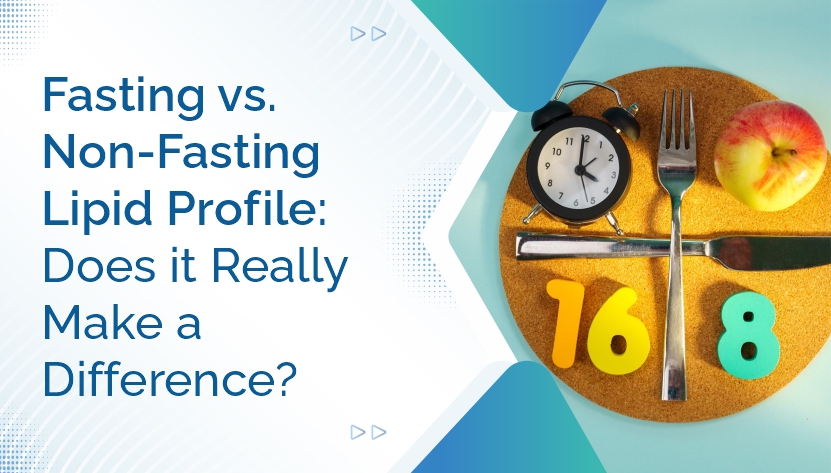


Monitoring cholesterol levels is one of the most important steps in assessing cardiovascular health. A lipid profile test helps measure different types of fats in your blood, including total cholesterol, LDL (bad cholesterol), HDL (good cholesterol), and triglycerides. For decades, patients were routinely instructed to fast for 8–12 hours before getting their lipid profile tested. However, modern research and updated clinical guidelines have changed the way healthcare professionals view fasting requirements.
Today, many laboratories and healthcare providers accept non-fasting lipid profiles as a reliable method for assessing cholesterol levels in most individuals. This has raised an important question: Does fasting really make a difference in lipid profile results?
What Is a Lipid Profile Test?
A lipid profile is a blood test that evaluates the amount of fats (lipids) circulating in your bloodstream. These measurements help assess your risk of heart disease, stroke, and other cardiovascular conditions.
A standard lipid profile includes:
Total Cholesterol
The overall amount of cholesterol present in your blood.
LDL Cholesterol (Low-Density Lipoprotein)
Often called "bad cholesterol," LDL contributes to plaque buildup in arteries.
HDL Cholesterol (High-Density Lipoprotein)
Known as "good cholesterol," HDL helps remove excess cholesterol from the bloodstream.
Triglycerides
A type of fat that stores excess energy from food. High triglyceride levels are associated with increased cardiovascular risk.
Non-HDL Cholesterol
Calculated by subtracting HDL cholesterol from total cholesterol. It represents all harmful cholesterol particles.
What Does "Fasting" Mean Before a Lipid Profile?
A fasting lipid profile requires:
Traditionally, fasting was recommended because eating can temporarily increase triglyceride levels, potentially affecting test accuracy.
What Is a Non-Fasting Lipid Profile?
A non-fasting lipid profile is performed without requiring prolonged fasting.
Patients can:
The blood sample can be collected at any time of the day regardless of recent food intake.
This approach is increasingly preferred because it is:
Why Was Fasting Traditionally Recommended?
Historically, fasting was considered essential because:
Triglycerides Rise After Meals
When you eat, especially foods rich in carbohydrates or fats, triglycerides increase as the body processes nutrients.
LDL Calculation Was Affected
Many laboratories estimated LDL cholesterol using the Friedewald equation:
LDL = Total Cholesterol – HDL – (Triglycerides ÷ 5)
Since triglycerides fluctuate after meals, LDL calculations could become less accurate.
Standardization
Fasting provided consistent testing conditions for comparing results across different individuals and laboratories.
For many years, these reasons led healthcare providers to routinely require fasting.
What Happens to Lipid Levels After Eating?
Interestingly, eating has less impact on most cholesterol measurements than many people assume.
Total Cholesterol
Minimal change after meals.
Typical variation:
HDL Cholesterol
Remains relatively stable.
Typical variation:
LDL Cholesterol
Usually changes very little.
Typical variation:
Triglycerides
Most affected by food intake.
Typical variation:
This means that while triglycerides may rise after eating, most cholesterol values remain remarkably stable.
What Do Current Medical Guidelines Say?
Several major cardiovascular organizations now support non-fasting lipid testing for routine screening.
These include:
Their recommendations are based on extensive research showing that non-fasting cholesterol measurements are generally sufficient for cardiovascular risk assessment.
Studies involving hundreds of thousands of patients have demonstrated that non-fasting lipid levels predict heart attack and stroke risk almost as effectively as fasting measurements.
Advantages of Non-Fasting Lipid Testing
1. Greater Convenience
Patients no longer need to schedule morning appointments or skip breakfast.
This improves accessibility and participation in routine health screenings.
2. Better Patient Compliance
Many people postpone testing because fasting is inconvenient.
Non-fasting testing encourages more individuals to complete recommended cholesterol checks.
3. Safer for People with Diabetes
Long fasting periods can increase the risk of:
Non-fasting testing reduces these risks.
4. Reflects Real-Life Metabolism
People spend most of the day in a fed state rather than fasting.
Non-fasting lipid measurements may better reflect how the body handles fats during everyday life.
5. More Flexible Laboratory Scheduling
Patients can have blood tests performed at any time rather than only in the morning.
This reduces crowding and improves healthcare efficiency.
When Is a Fasting Lipid Profile Still Necessary?
Despite the advantages of non-fasting testing, fasting remains important in certain situations.
1. Very High Triglycerides
If non-fasting triglycerides exceed:
400 mg/dL (4.5 mmol/L)
A fasting lipid profile is usually recommended for confirmation.
2. Suspected Familial Lipid Disorders
Patients with inherited cholesterol disorders may require fasting measurements for accurate diagnosis.
Examples include:
3. Monitoring Severe Hypertriglyceridemia
Patients receiving treatment for extremely high triglycerides may need fasting testing to accurately evaluate treatment effectiveness.
4. Follow-Up After Abnormal Results
Doctors may order fasting testing if a previous non-fasting profile produced unexpected or borderline results.
5. Certain Research or Specialist Evaluations
Some cardiology and endocrinology assessments still prefer fasting samples for standardization.
How Food Affects Triglyceride Levels
Triglycerides are the component most influenced by eating.
After a meal:
Step 1: Fat Absorption
Dietary fats are absorbed through the intestines.
Step 2: Chylomicron Formation
The body packages fats into particles called chylomicrons.
Step 3: Bloodstream Transport
These particles circulate in the blood and temporarily increase triglyceride levels.
Step 4: Clearance
Within several hours, triglycerides gradually return toward baseline levels.
This natural process explains why triglycerides are higher after meals.
Which Test Is More Accurate?
The answer depends on the purpose of testing.
For Routine Screening
Non-fasting lipid profiles are generally accurate enough.
Most doctors can confidently assess:
without requiring fasting.
For Detailed Triglyceride Evaluation
Fasting may provide greater accuracy.
This is particularly important when:
For LDL Cholesterol Measurement
Modern laboratories increasingly use direct LDL measurement techniques.
These methods are less affected by fasting status, reducing the need for fasting.
Understanding Non-HDL Cholesterol
Many experts now emphasize non-HDL cholesterol as an important cardiovascular risk marker.
Formula
Non-HDL Cholesterol = Total Cholesterol – HDL Cholesterol
Advantages:
Some specialists consider non-HDL cholesterol more useful than LDL cholesterol alone.
Can a Heavy Meal Distort Results?
Yes, extremely large meals can affect triglyceride measurements.
Examples include:
To improve accuracy:
This helps ensure more representative results.
Fasting vs. Non-Fasting Lipid Profile: Side-by-Side Comparison
| Feature | Fasting Lipid Profile | Non-Fasting Lipid Profile |
|---|---|---|
| Food restriction | 8–12 hours | None |
| Convenience | Lower | Higher |
| LDL accuracy | Excellent | Excellent in most cases |
| HDL accuracy | Excellent | Excellent |
| Total cholesterol accuracy | Excellent | Excellent |
| Triglyceride accuracy | Highest | Slightly variable |
| Diabetes safety | Lower | Better |
| Routine screening | Suitable | Preferred by many guidelines |
| Severe triglycerides | Preferred | May require follow-up |
Tips for Getting the Most Accurate Lipid Test Results
Whether fasting or non-fasting:
Stay Hydrated
Drink water before testing unless instructed otherwise.
Avoid Alcohol
Alcohol can significantly raise triglyceride levels.
Maintain Normal Eating Habits
Do not overeat or drastically restrict food intake before testing.
Inform Your Doctor About Medications
Certain medications may affect lipid levels.
Examples include:
Follow Laboratory Instructions
Always follow specific guidance provided by your healthcare provider or laboratory.
Common Myths About Lipid Testing
Myth 1: Fasting Is Always Required
Modern guidelines show that most routine cholesterol screenings can be performed without fasting.
Reality:
Non-fasting testing is often sufficient.
Myth 2: Eating Before the Test Makes All Results Useless
Only triglycerides are substantially affected by recent meals.
Reality:
Total cholesterol, HDL, and LDL usually remain reliable.
Myth 3: Fasting Gives Better Heart Disease Risk Prediction
Research shows non-fasting results predict cardiovascular events almost as effectively.
Reality:
Risk assessment remains highly accurate.
The Future of Lipid Testing
Advances in laboratory technology continue to reduce dependence on fasting samples.
Emerging trends include:
As these technologies become more common, fasting requirements may become even less important for routine testing.
Conclusion
The long-standing belief that everyone must fast before a lipid profile is gradually changing. Current evidence shows that non-fasting lipid profiles are reliable for routine cholesterol screening and cardiovascular risk assessment in most people. Total cholesterol, HDL cholesterol, and LDL cholesterol remain relatively stable after eating, while triglycerides are the primary measurement affected by food intake.
Fasting lipid profiles still play an important role in specific situations, such as evaluating very high triglycerides, diagnosing inherited lipid disorders, or investigating abnormal results. However, for the majority of healthy adults undergoing routine cholesterol checks, a non-fasting lipid profile provides accurate and clinically useful information.
Food-related reactions are often lumped together under a single umbrella, but food...
17-09-2026
For decades, cholesterol testing has been the cornerstone of cardiovascular risk...
17-09-2026
Chronic fatigue syndrome (chronic fatigue syndrome), also known as myalgic encephalomyelitis...
17-09-2026
Book lab tests, access reports instantly, and get seamless home sample collection with advanced technology.
Trusted by millions, Ampath Labs ensures accurate diagnostics, convenience, and care at your fingertips.



 Select Location



 Get 15% OFF on 1st order above ₹100 Use code:



































































.jpg)